
AI Ad Generation
Shopify Facebook Ads: Creative That Converts
Shopify Facebook ads: use the photo on the product page, test a few custom stills, and let catalog cover the rest.
 Kris Kostov8 min read
Part of Best AI Ad Generator 2026: 9 Tools, Real Prices
Quick answer
Shopify Facebook ads convert when the creative is built from a real product photo and the click lands on the matching product page. Catalog ads can cover the rest of the SKUs. They cannot invent a reason to stop. Design a few custom stills for the products you want to learn from, score them, then spend.
Most “how to run Shopify Facebook ads” pages walk you through a pixel, a campaign objective, and a budget. That setup matters, and Shopify documents the Meta channel in its help center. It is not why the ad fails. The ad fails because the image could be any store’s bottle, tee, or gadget, and the first line does not say why this one.
This is the creative half. For the still-image rules, read what static ads are. For the wider tool field, the best AI ad generators comparison is the map.
What counts as a Shopify Facebook ad?
It is a Meta ad whose job is to sell something you fulfill in Shopify. The person seeing it usually does not follow you. They decide in a glance, then they should land on the product or collection the ad just showed. Not the homepage, and not a different SKU.
Two production paths sit under that job. Catalog, or dynamic, ads pull the image, title, and price from the product feed Meta already has. Custom ads are images and videos you make on purpose. You will use both if the catalog is large. You should not pretend they are the same test.
Should you use catalog ads or custom creative?
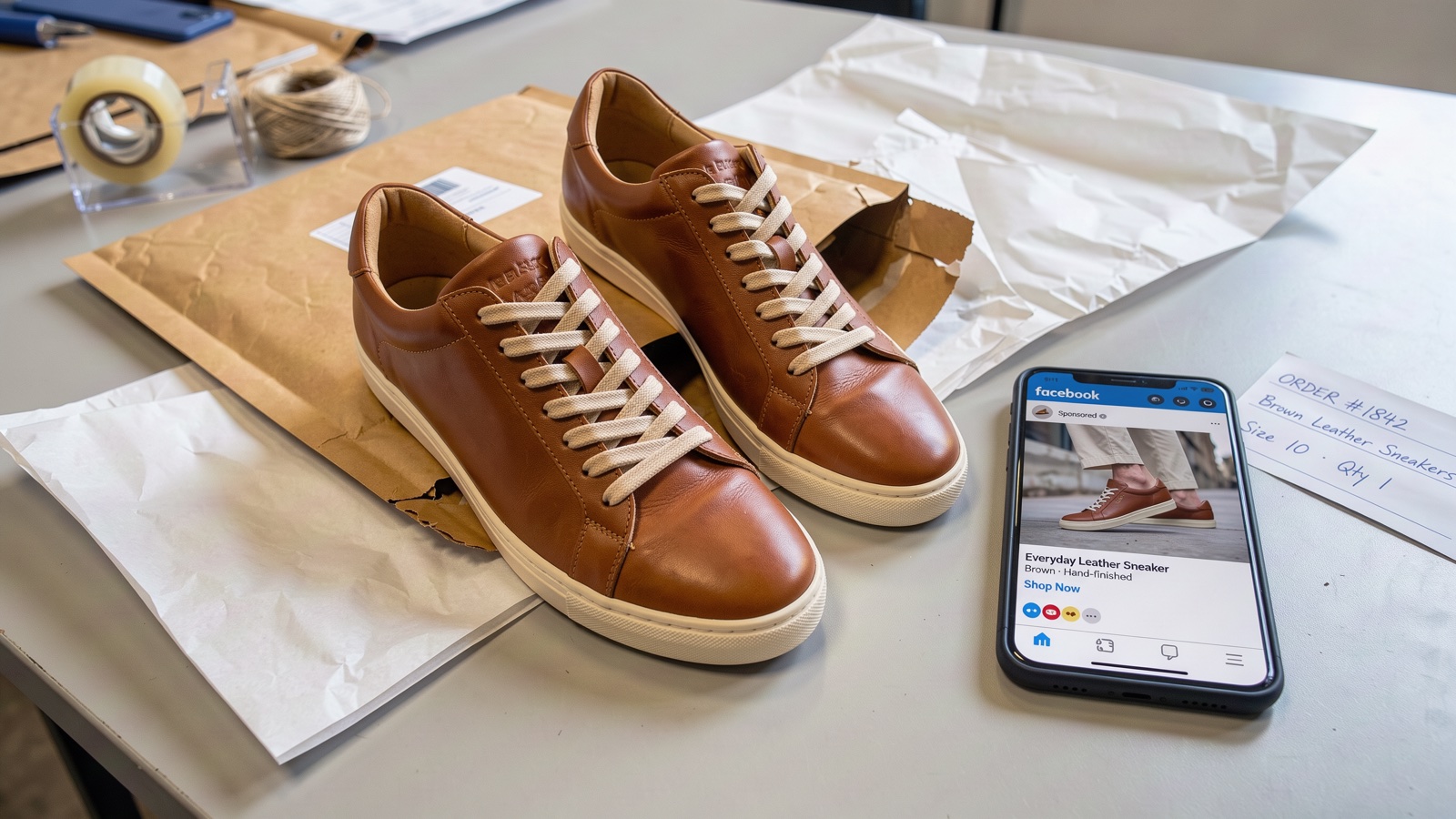
Catalog is how you stay present on SKUs you will never art-direct. It inherits the primary image in Shopify. If that image is a dark packshot with a tiny label, every automated placement inherits the problem. Fix the hero image before you “scale the catalog.”
Custom creative is how you learn. Pick the product with margin, stock, and a sentence you can say out loud. Build a 4:5 still (Meta’s Ads Guide recommends 1440 × 1800 for the Instagram Feed) and, if motion is the proof, one short video from the same photo. Change the hook. Keep the product recognizable so the click is not a surprise.
Advantage-style campaign setups can mix placements and even pull catalog items into a broader campaign. That does not remove the need for a frame you would be willing to put next to your best competitor. Volume on a weak primary image is just a faster way to pay for indifference.
Which product photo should you start from?
Use the frame already on the product page if a stranger can tell what it is at phone size. Lifestyle helps when the product is small or ambiguous. It is not a requirement for a bottle, a shoe, or a tool that reads in a packshot.
Skip photos that need a caption to explain the object, photos where the product is a speck in a room, and photos you would not put on the page you are sending people to. The ad and the landing image should feel like the same product. A generated scene is fine. A different product is not.
What formats does a Shopify store need first?
Start with one still and one decision: does this product need motion? If it does not, do not wait on video. The feed still is the test. The Instagram ad size for that still is 4:5. Square can wait for carousel cards.
- Hero still. Product large, one line, offer only if you actually have one.
- Proof still. A review you can quote, a count you can verify, or a before/after that is real.
- Short video, second. Only after a still has a hook worth repeating. The AI UGC ads guide covers creator-style motion if that is the category’s native look.
Organic posts are a different asset. A month of 4:5 captions is a Social Pack, not a prospecting ad. Do not mix the two in one test and then blame the product.
How do you stop designing every SKU?
Rank products by what you can learn, not by how many you have. A store with 200 SKUs does not need 200 concepts in week one. It needs a handful of products where a win would change the week’s revenue, plus a catalog safety net for the rest.
For each of those products, test angles, not color tweaks. Problem, proof, offer. The same rule is in how to make Facebook ads that convert. Kill the stills that do not earn a click before you duplicate them across lookalikes and countries.
Then roast the frame before the learning phase. AdRoast turns the Shopify product photo into feed ads from presets and scores the result. It does not install in Shopify, run the campaign, or take a percent of spend. The generator page is the AI ad generator for Shopify. You still launch the ad yourself, on the URL that matches the product in the picture.
What are Shopify Facebook ads?+
Shopify Facebook ads are Meta campaigns that sell a Shopify product. The store stays in Shopify. The click lands on a product or collection page. The ad itself is either a catalog card pulled from your product feed or a custom image or video you designed. The feed does not replace the creative.
Do I need a Shopify app to run Facebook ads?+
You need the product on Shopify and a way to send traffic to it. Meta’s sales channel can sync the catalog. You do not need an app to design the ad. Generating creative from the product photo you already shot is a separate step from installing a pixel or a channel.
Should I use catalog ads or custom ads?+
Use catalog ads to cover the SKUs you are not hand-designing. Use custom ads for the products you actually want to learn from: a hero, a new launch, a bundle. Catalog scales whatever primary image you gave it. A weak packshot at volume is still a weak ad.
What creative should a Shopify store test first?+
Start with the product you can fulfill and explain in one line. Make a 4:5 still and, if the product needs motion, one short video from the same photo. Change the hook across variants. Do not open by designing a unique ad for every SKU in the catalog.
How is this different from organic Instagram posts?+
A paid ad has to win a cold thumb and then survive the click to the product page. An organic post can be softer, because the follower already knows you. Do not paste the organic caption onto a prospecting ad and call it a test. The job is different.