
AI Ad Generation
Instagram Ad Size: 4:5 Feed at 1440×1800
Instagram Feed ads are 4:5 at 1440 × 1800. Stories and Reels are 9:16. One file cropped into both will cut the product.
 Kris Kostov7 min read
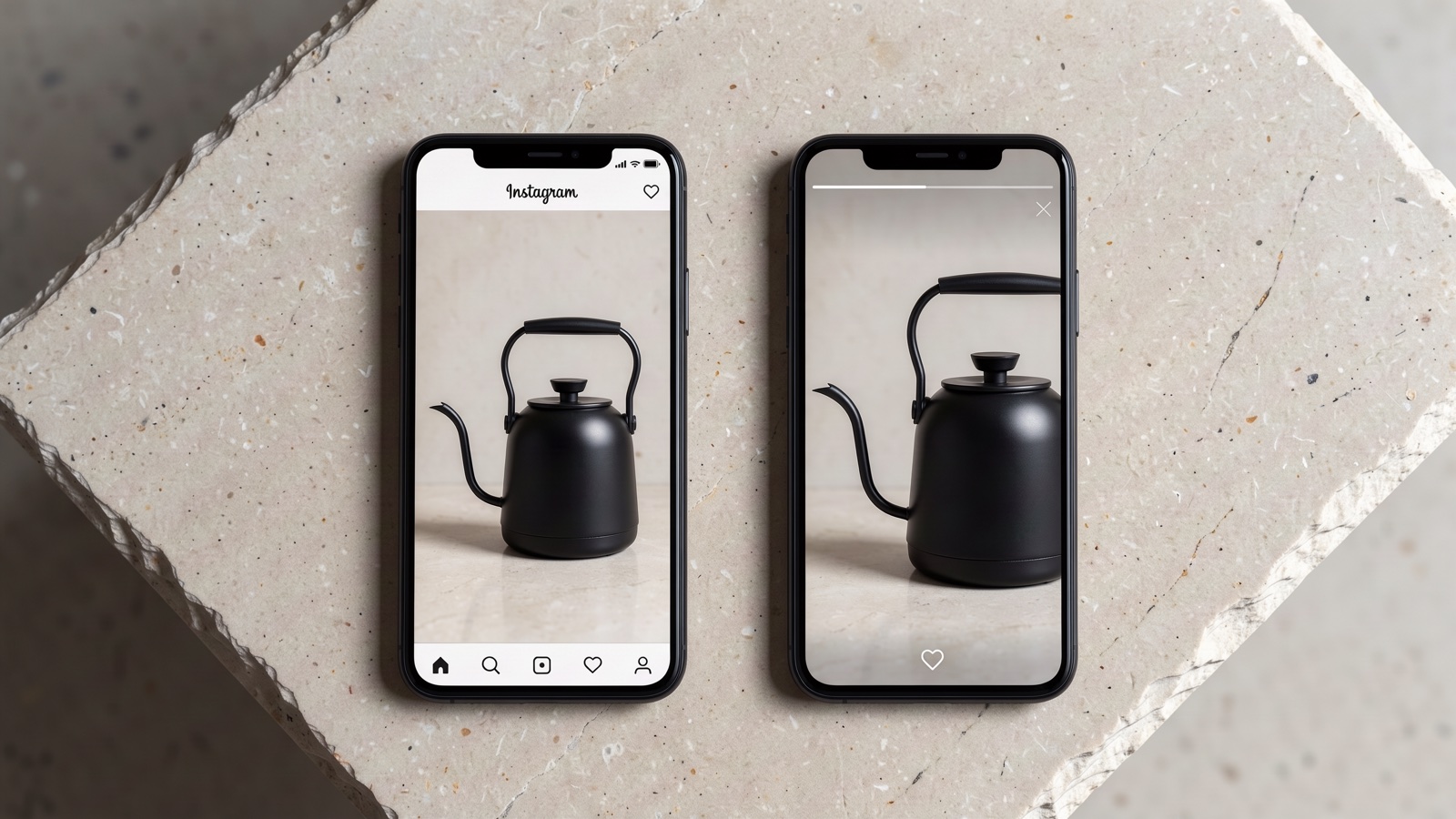
Part of Best AI Ad Generator 2026: 9 Tools, Real Prices
Quick answer
The Instagram ad size for a feed image is 4:5, exported at 1440 × 1800 pixels. That number is on Meta’s Ads Guide, not a template site. Stories and Reels are a separate 9:16 file. If you upload one square and let Meta crop it, the product gets cut.
People search “Instagram ad size” because a still that looked fine on a desktop preview showed up on a phone with the label missing. The fix is two exports and a product that sits in the middle of both. Pixel hunting beyond that is how a launch slips a day for no extra clicks. Those pixels are the same in the UK, Australia, New Zealand, and the EU. Meta does not publish a local ad size. British results call this file a Facebook advert size. A feed photo that is not an ad is a different export, covered in Instagram post size.
Sizes are the container. The idea inside them is the static ad. Where that still sits in a Facebook campaign is covered in Facebook ads that convert.
What is the Instagram ad size for Feed?
Meta’s Instagram Feed image spec recommends a 4:5 ratio at 1440 × 1800 pixels. Accepted files are JPG or PNG, up to 30 MB, with a minimum width of 500 pixels. Primary text is recommended at about 125 characters and the headline at about 40. The image can be other ratios, from a tall 4:5 out to a wide 1.91:1. 4:5 is the one that uses the feed.
Design at 1440 × 1800 even if a tool offers 1080 square as the default. The square will run. It will also leave a shorter image in a placement that would have given you more of the screen.
| Placement | Shape | Export |
|---|---|---|
| Instagram Feed | 4:5 | 1440 × 1800 |
| Facebook Feed | 4:5 | 1440 × 1800 |
| Stories and Reels | 9:16 | Vertical file, product inside the safe area |
| Carousel cards | 1:1 | 1080 × 1080 or larger |
What size are Stories and Reels ads?
Stories and Reels are 9:16. The interface covers the top and the bottom: profile, CTA, captions. Put the product and any words in the middle band. A feed image dropped into these placements gets blown up and cropped, which is how labels disappear.
Meta’s minimum-size help page still lists 1080 × 1080 for Instagram Stories, Instagram Reels, and Facebook Stories. That page says those are minimums and points you to the Ads Guide for the real spec. Treat 1080 square as the floor a file must clear, and design a vertical 9:16 anyway. Check the current Stories and Reels pages in the Ads Guide before a big export, because those two Meta documents do not always match.
Do Facebook and Instagram use the same ad size?
For the feed, yes. The Facebook Feed image spec recommends the same 4:5 at 1440 × 1800. “Facebook ad size” and “Instagram ad size” are the same file for that placement. They are not the same file as the right column, Marketplace, or a vertical story.
The help-center minimums are the messy part. Facebook Feed on that page is listed as 1080 × 1080 for 1:1 and 1440 × 1800 for 4:5. Instagram Feed on the same page is listed only as 1080 × 1080. Exporting the Ads Guide’s 1440 × 1800 file satisfies the taller recommendation and stays above those minimums. Exporting only the 1080 square meets the help page and wastes the feed.
What about carousels and square ads?
Carousel cards want a consistent square, 1080 × 1080 or larger, so the set does not jump between shapes. Use that when you are showing steps, a kit, or several products. Do not use a carousel because you could not decide which still was the ad. One strong 4:5 beats five undecided squares.
How do you keep the product from being cropped?
Keep the product inside the center of the 4:5, with a margin, and again inside the center of the 9:16. Type on the image stays to one short line. Everything else goes in the primary text, which Meta can truncate, so the first line of that text has to carry the hook. That is the same rule as ad copy that converts, applied to a box instead of a script.
If you are generating the still from a product photo, generate the 4:5 and the 9:16 as two outputs. A preset built for the feed will not automatically respect a Story UI. AdRoast’s paid creatives are aimed at those Meta placements; organic 4:5 posts from Social Pack are a different job and a different crop. Preview both files at phone width before you upload them.
What is the best Instagram ad size?+
For a single image in the feed, use 4:5 at 1440 × 1800 pixels. That is the ratio and resolution on Meta’s Ads Guide for Instagram Feed. It also matches the Facebook Feed recommendation, so one export covers both feeds. Square is the fallback, not the default.
What size are Instagram Stories and Reels ads?+
Stories and Reels are vertical, 9:16. Keep text and the product out of the top and bottom UI. Meta’s help-center minimum table still lists 1080 × 1080 for several of those placements, which is a floor, not the shape you should design. Design the tall frame.
Can I use one image for every placement?+
You can let Meta crop one file into every placement. You should not. A 4:5 feed image cropped into 9:16 will cut heads and products. Export a feed still and a vertical still. Same idea, two frames.
What file type should an Instagram ad be?+
JPG or PNG. Meta’s Instagram Feed spec allows up to 30 MB and recommends those two types. A 1440 × 1800 JPG is enough. You do not need a print-resolution file, and you should not upload the minimum width and hope it stays sharp.
How much text should be on the image?+
As little as the idea allows. Meta recommends about 125 characters of primary text and a 40-character headline beside the Instagram Feed image. The words baked into the picture should be one line a person can read without tapping. The caption can carry the second sentence.